In the stunning setting of London’s Olympic Park, in the East of the City, the 2019 EUGIC conference showcased the best of pan European learning focused on creating resilient, healthier cities through nature-based solutions and water sensitive urban design.
The programme encompassed a huge variety of topic areas ranging from the financing of green infrastructure to the connection between green infrastructure and health and well-being objectives. Dr Mark Nieuwenhuisjen presented some compelling evidence to suggest that
the quality urban forest has a direct impact on the longevity of city dwellers globally.
Creative and innovative solutions to our climate crisis were showcased from Alex Bond’s focus on biophilic design for the future of London’s neglected roof spaces, to the work of Dr Phoebe Carter incorporating biodiversity and city habitat space for the wellbeing of humans and animals alike.
The audience were provided insight from major developers such as the Berkeley Group as to how they have incorporated the principles of biodiversity net gain to achieve higher quality landscape developments. However, there is a concern that through utilising private consultants to create specific net again metrics, which tweak the guidance provided by Defra and Natural England, that there will be less transparency in this process. However, let us remain optimistic that the modification of such toolkits will yield even better results for all stakeholders in the long term.
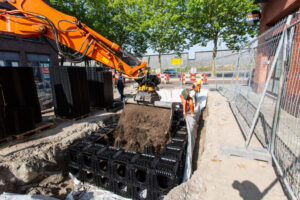
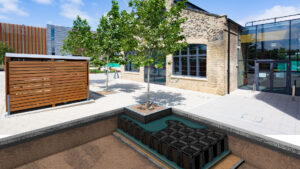
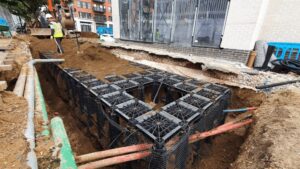
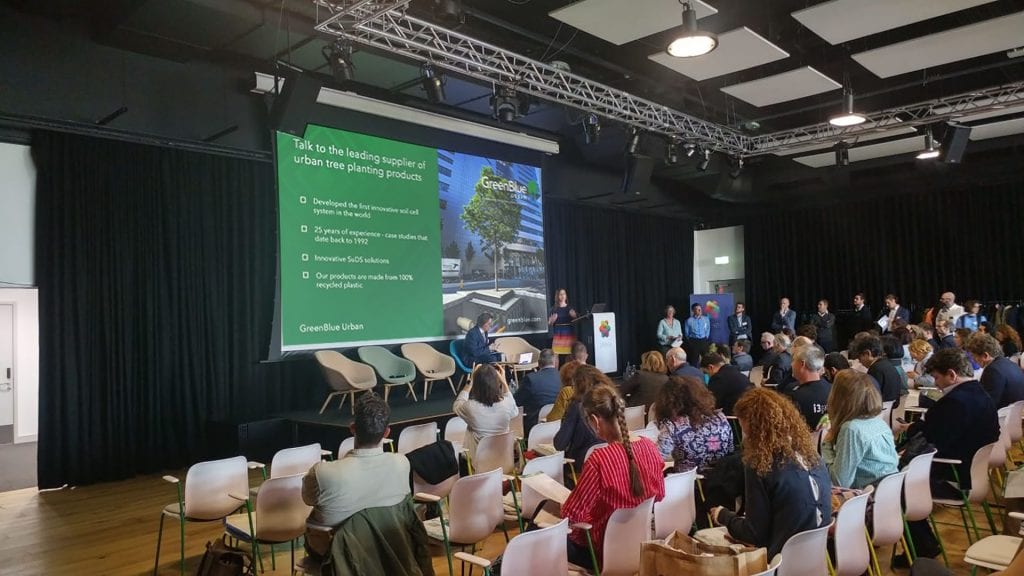
Green Blue Urban’s very own Charlotte Markey presented the work she has been delivering as part of the Water Resilient Cities EU Interreg Project and she also shared the floor with Mr Ian Titherington with whom she has collaborated to deliver some of the most innovative SUDs retrofit schemes in the UK- Greener Grangetown. Charlotte and Ian focused on the necessity of communicating green infrastructure and SUDs to the wider community. Over 40 languages are spoken in the electoral ward in which GreenBlue Tree Pit Raingardens were integrated and so visuals are key to providing insight to end users of schemes.
This theme of communication was picked up by Arit Anderson, award-winning garden designer and much-beloved host of BBC 2 Gardner’s World. It was also highlighted by the Founder of London’s National Park City Campaign – Daniel Raven-Ellison. Campaigns and grassroots approaches to the delivery of the landscape of the future will act as a catalyst for policy change and more creative ‘green engineering solutions’. As Sue Illman from IllmanYoung emphasised, policy change will be critical to achieving the outcomes on schemes of all scales.
The conference provided great opportunities for the GreenBlue Urban team to engage in the ‘Industry Speed Dating’ activity connecting solution providers and technical expertise with public and private sector stakeholders seeking to pilot and test in live projects.
All in all there were some key lessons learned throughout the course of the two day proceedings – notably
the need to revise the way we finance our urban forest and wider green infrastructure objectives, how and to whom the vision is communicated and how applied concepts can create resilience across the EU.
Learning from Horizon 2020 projects such as Urban GreenUp highlighted just how cross-pollination of ideas across EU projects can yield insights that will benefit the lives of citizens in towns and cities across Europe.