Recently Charlotte Markey had the pleasure of talking to Peter Massini, Principal Green Infrastructure Officer at the Greater London Authority.

The environmental focus for the GLA are addressing a number of key issues covering Parks and Green Spaces, Pollution and Air Quality, Climate Change and Water to name a few – all key topics affecting the well being of those that live and work in the nation Capital.
Having previously collaborated alongside Peter and other colleagues who formed part of the working group for the Natural Infrastructure Taskforce Report – established following the publication of the London Infrastructure Plan 2050, which sets out the infrastructure needs for London over the coming decades. The plan acknowledged that green infrastructure must be considered as an integral part of the city’s vital systems; as essential as the city’s transport, energy, water, waste and digital infrastructure.
It is clear that Peter’s team are striving to embed a new approach to green and blue infrastructure across the capital. Peter has always promoted a definition of green infrastructure that focuses on the tangible benefits that integrating nature into the built environment must and should provide. If we are to press ahead with natural capital accounting methods and search for new and innovative ways including SUDS systems to fund and sustain green and blue infrastructure we have to focus on the business case.

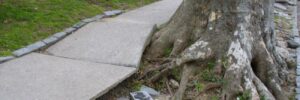
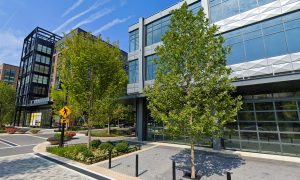
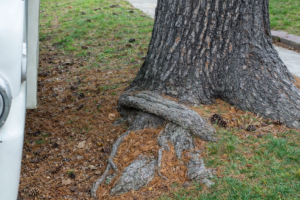
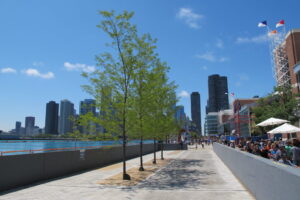
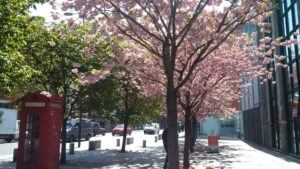
It was insightful to talk to Peter during our recent Podcast about the specific role street trees play within his overall understanding of green infrastructure. He rightly points out that the integration of street trees often constitutes the most visible and highly valued aspect of nature in urban communities. Therefore, at GreenBlue Urban, we believe that our urban trees have to do more for less. If, as Peter asserts, we are looking at a future where streets will look and feel completely different, focused more on a shared space model where trees are not just placed at the side of the highway but actively part of the highway, then we have to come up with the innovative solutions. These would capitalise on the benefits that can be accrued from planning our streetscapes differently.

One of the golden threads that really came out of my time with Peter was that the real challenge as to what could be termed as normalising nature. Once it becomes commonplace that all the boroughs and key stakeholders in the capital embed natural infrastructure across all policy areas to deliver the valuable ecosystems services to increase resilience, add value to communities through health and economic improvements, schemes that would of once been impossible become possible.
Listen to Peter Massini’s full Podcast here!