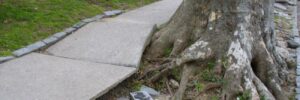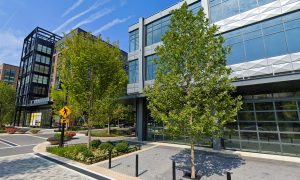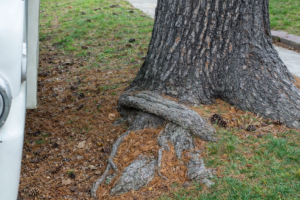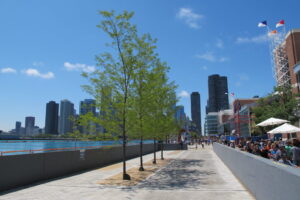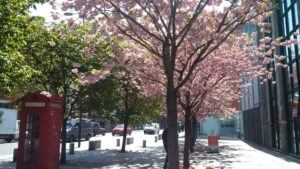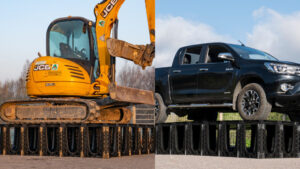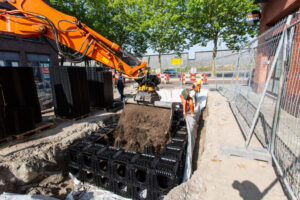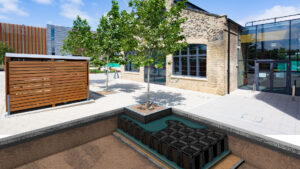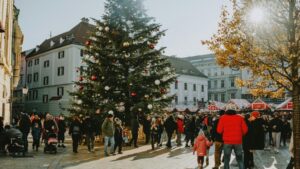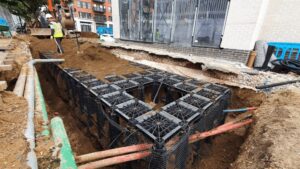
Clearly, we cannot just simply drop trees in anywhere. To have a chance of success, tree species and location are the first priority in our goal of establishing trees in cities. Planting potentially large trees in wrong locations is counterproductive and will simply turn people against trees. However, equally often we see tree planting sites which could support larger species, populated with smaller ‘whitebeam’ or ‘prunus’ species which really represent a lost opportunity. Big trees bring big benefits but they must be located wisely.
Right Tree, Right Place
Trees need space, they need soil volume – there is a direct correlation between what we provide the tree with to grow below ground and with the result we will see above ground.
Architects and engineers would never seriously consider building a structure with inadequate foundations and yet many will routinely plant trees on their plans in tiny tree pits just a fraction of what they really need to do well.
Where possible, plant trees in groups with shared soil space. Trees can then spread out happily between themselves and benefit from additional soil volume. One common method is the use of continuous trench planting or shared tree pits. This is a very good way of providing adequate volume.
 Large parking lots without trees are urban hot spots and missed opportunities
Consider Urban Tree Plantings in the Following Locations
Bump outs in road schemes – Build outs are one of the most demanding places to plant a tree, but one in which successful established trees have a huge impact. These can be used as part of traffic calming projects (thus fulfilling two roles in one), or simply parking delineation.
 A “bump out” with a newly planted tree in a road reconstruction
Verges – The narrow strip of turf bordering on a sidewalk or roadway is the most common area for urban tree location.
Pavement – Demanding on the tree but suspended pavement applications can be achieved successfully with appropriate tree planting systems and careful attention to tree pit design.
Parking lots – Again a potentially hostile place to plant a tree without proper consideration, but greatly beneficial in providing cool shade for vehicles in bright weather.
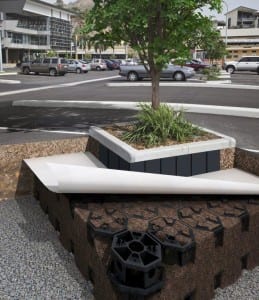 Successful tree planting in parking lots, with no reduction in parking space
Plazas – These are where trees can really have huge aesthetic and beneficial impact – there is nothing else that can be incorporated in these kind of spaces that will confer the same degree of benefit.
Parks – Few things can compete with established trees in a park setting – indeed try imagining a park without trees.
Urban forest pockets – Creating tree clusters in urban spaces and pocket parks is an excellent strategy to increase tree canopy for climate mitigation and adaptation.
SUDS (sustainable urban drainage systems) – Consider the use of trees as part of a stormwater retention strategy – SUDS tree pit designs are becoming an increasingly successful urban drainage method.