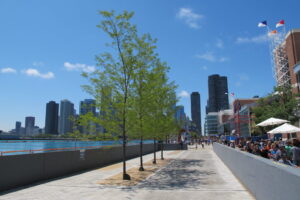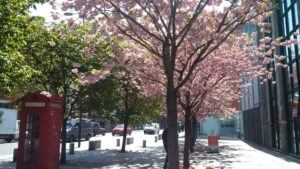
There is benefit for all of us in the elevation of arboriculture to its deserved importance in urban regeneration. The expectations of an increasingly affluent society for a green and pleasant environment in which to live, work and play has resulted in local authorities, developers and employers competing to attract residential, commercial and civic prosperity.
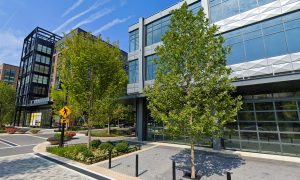
In the past, urban tree planting rarely achieved the splendid dense mature canopies we hoped for. GreenBlue Urban’s study of optimum conditions for tree welfare over the past twenty-five years has not only changed our understanding of why, it has produced solutions to the challenges faced by tree roots in urban environments.
Belatedly, the essential function of the below-surface conditions is now recognised. We enjoyed walking in rural woodlands, feeling the soft leaf-strewn compost underfoot. Could ways be found to really reproduce in urban afforestation that pristine, sylvan root environment?
Without deliberate interventions, the alien soil conditions in urban environments are incompatible with a luxurious green tree canopy. For more than twenty years GreenBlue Urban, in collaboration with universities and professional associations, has been researching ways to re-create, as far as possible in cities, that un-spoiled woodland floor – the optimum conditions for tree root health and development – but also while preserving the built infrastructure so important to urban settings.
Tree planting and nourishment is a vital part of the measures being taken to combat global warming. The contribution trees make to carbon dioxide reduction is well documented and, in itself, justifies the focus on arboricultural welfare. The successful greening of the urban environment, once a desirable add-on, is now an essential requirement of any self-respecting scheme.
Blocking of the soil porosity through compaction or waterlogging suppresses the exchange of oxygen and carbon dioxide by partial, or even complete, occlusion of the normal soil structure diffusion channels. The roots are deprived of the essential nourishment to be expected from a given soil volume.
Measures to ensure that tree roots seek their aeration and nourishment in porous, normal soil structure diffusion channels have conclusively demonstrated the futility of restricting irrigation and aeration to shallow sub-surface systems. Most automatic drip irrigation systems fail to direct water to deeper soil volumes that are vital for nutritional and structural benefit.
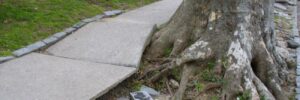
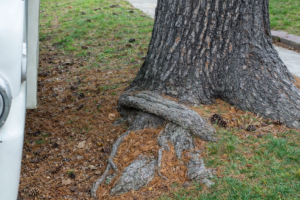
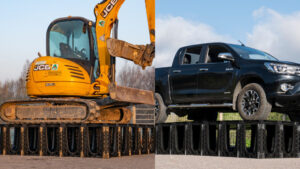
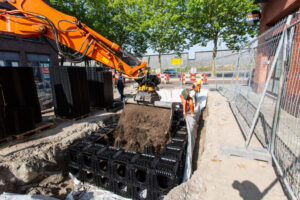
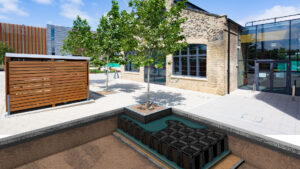
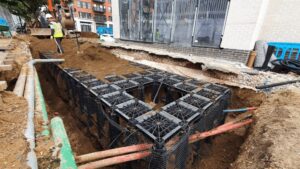
GreenBlue Urban structural, modular soil systems such as StrataCell and RootSpace have been proved to rectify a number of problems associated with townscape tree planting and growth. Pavement heave doesn’t happen when proper irrigation/aeration is designed and installed in the tree pit. Tree roots are encouraged to go deeper rather than fight for nourishment from compacted anaerobic soil near the surface. Structurally safe below ground with depth questing roots, the tree canopies also become less susceptible to destruction even with their enhanced volume and density.

Given well-aerated soil conditions, roots are content to deflect around service ducting rather than trying to destructively push it out of the way.
Contrary to expectations, research shows that the removal, loss and absence of leaf litter are of relatively minor consequence. It is mainly compaction, waterlogging and pollution that precipitate the collapse of the aeration cycle and the consequent root starvation. The gas diffusion rate in water is only 0.0001% of the rate in air (Hillel, 1998).
Soil organic matter has three essential functions in healthy tree root growth. In addition to sustaining soil pore openness and providing easily assimilated root growth food, it facilitates the uptake of ground water. The interaction between fine tree roots and their co-dependant mycorrhizal fungi is the principal source of soil organic matter for tree growth. This is further evidence of the essentiality of avoiding shallow systems in favour of providing, from the planning stage, sufficient depth of viable root volume and soil conditions.
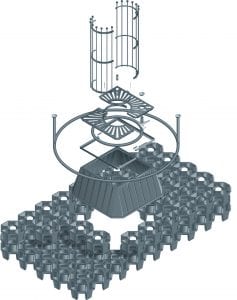
RootRain irrigation and aeration systems, developed by GreenBlue Urban in 1992, allows water and oxygen to penetrate deep into the trees rooting zone, as opposed to surface water. This encourages tree roots to establish at a deeper profile, far enough away from the paved surface.
David Bowie