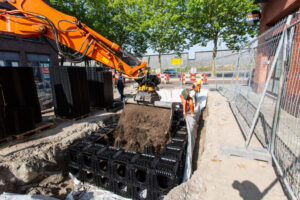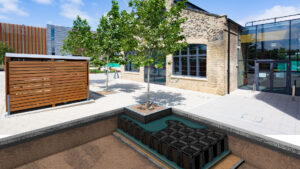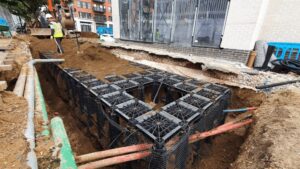
It has been an incredible journey for the last three years working on the Water Resilient Cities project. The final conference was held in Peterborough, which included a site visit to one of the flagship Arborflow GBU SUDs tree pit schemes at Fletton Quays. The event was an opportunity for members of local authorities, private consultancies and others to derive benefit from the French, Dutch and Belgian perspectives on the project. Topics ranged from modelling software to the cost/benefit analysis approaches the ADOPTA agency in France have used to make the case for SUDs.

One of the most exciting presentations was delivered by Bob Bray of Robert Bray Associates who explained how they approached the ‘De Overloper’ project in Middleburg, NL and the importance of providing new insights for their Dutch clients in respect of water quality amelioration. Sharing knowledge in this manner was one of the objectives of this European work and to have one of the leading SUDS specialists in the UK sharing ideas and also learning from the Dutch context is a perfect example.

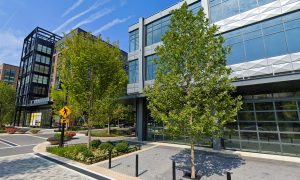
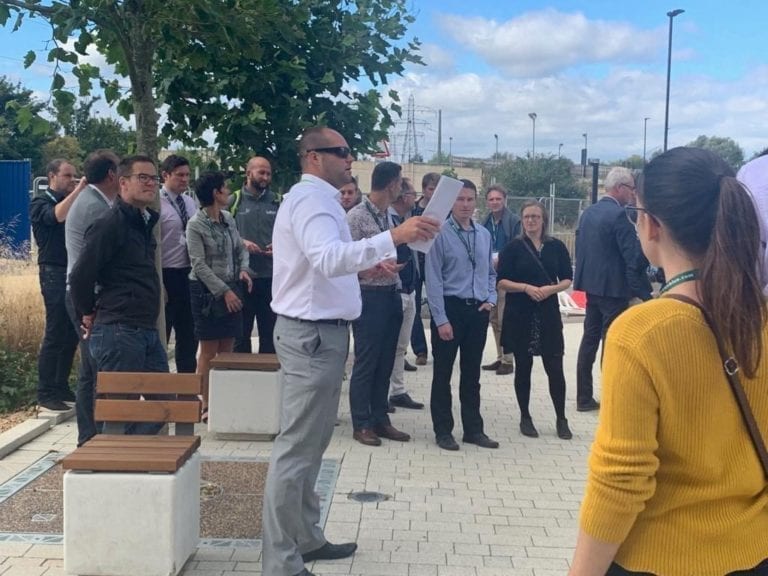
The site visit to Fletton Quays and the presentation about the scheme delivered by Andrew Leadbetter, Drainage Engineer for Peterborough CC gave French, Dutch and Belgian partners an opportunity to visit a medium sized town, outside of the London sphere with a different policy context and budget for SUDs. Andrew explained how retrofit components worked together, the need to reduce end of pipe solutions and gave insight into the co benefits they managed to capture on the scheme. This tied in well with the work VIVES University have been doing as part of the project, producing a toolkit to value retrofit scheme using metrics of economic, social and environmental benefits.
The event included a WRC Awards Ceremony and this was an exciting addition to proceedings which we hope will continue after the project ends. So, if you’ve got exciting SUDS projects keep documenting them and you never know, there could be an opportunity to win in 2020.

Most importantly the day enabled the partnership to present key outputs and to engage English audiences with the new SUDs guide as well as to present the future of the WRC network.
The WRC team would love to hear your ideas relating to the future of collaboration across the 2Seas area and the outputs that UK organisations feel would be most valuable. Options discussed have included:
- Study Tours of retrofit schemes across Europe
- Internship and Graduate Opportunities for design, engineering and planning roles across border
- SME network
- Product Testing Platform for Innovations
Please contact the WRC team through the website to provide feedback as to how this new network could work for you and your organisation.