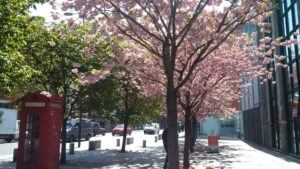
Whether you’re a landscape architect or other specifier working on a design, or a developer building a property, a quick and efficient sale for your finished project can be of utmost importance. Urban trees can contribute to reducing the length of time that properties spend on the market, increased exponentially by the presence of mature trees.
A study in Portland, Oregon to quantify the effect of trees on Portland’s housing market found that street trees added an average of $7,130 to the sale price of the house it fronts, and a total of $12,828 to the sale price of houses within 100 feet (30.5 m). In addition to trees increasing property values, street trees also reduced the time on the market by 1.7 days on average (Donovan and Butry, 2010). This study considered only trees in the municipal right-of-way between the sidewalk and the road.

These findings are also supported in the UK, where several local authorities have demonstrated that trees significantly contribute to the desirability of residential properties. One UK-based telephone survey of real estate agents in the Warwick area suggested that tree cover has a positive effect on housing saleability, if not directly on price, stating that properties on tree lined streets were said to be in higher demand and sell faster (Warwick District Council, 2011).
A reduction in the length of time properties are on the market, of any degree, will cumulatively contribute to significant cost savings to residential developers.
One article published in Money Magazine found that residential landscaping, including trees, offers a return on investment of 100% to 200% when the property is sold.

Anderson and Cordell (1988) quantified the effect of front-yard trees on the listing price of homes in Athens, Georgia using MLS photographs of houses. They found that a front-yard tree added $422 (approximately 1.1%) to the sale price of a house. Another study examined the effect that trees had on the selling price and time on the market of homes in Lehigh County, Pennsylvania, confirming that mature trees on a house lot increased its sale price. In addition, having trees on three sides of a house reduced time on the market, as did large trees behind a house although to a lesser degree (Culp, 2008).

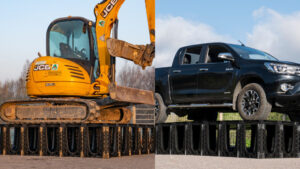
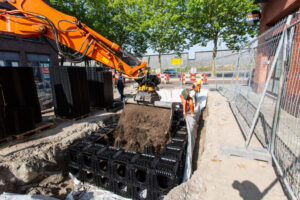
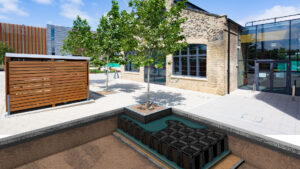
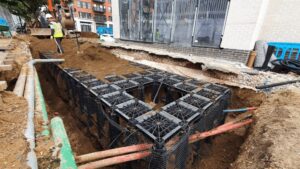
The challenge is that the places where the most people live, and therefore the have the most properties up for sale, provide the least optimal growing conditions for trees. There are ways to grow healthy mature trees in urban areas however, and for over 25 years GreenBlue Urban has been helping landscape architects and other urban design professionals make this a reality. The ArborSystem urban tree planting system provides everything a tree needs to thrive in even the harshest city settings.