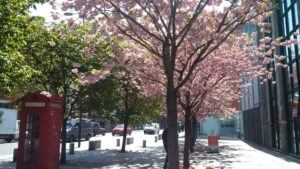
…the Blue Jacaranda!
This breathtaking tree with its large blue-purple blooms has been awarded as the 2023 Urban Tree of the Year by the Society of Municipal Arborists (SMA). This semi-evergreen boasts 20-inch leaves that are delicate and fern-like, blooms from May through the summer, and provides an eye-popping focal point to a garden or landscape.
The attraction of the Blue Jacaranda is its unique and elegant appearance. However, careful research is required for growing success. Species selection and rooting environment in terms of place, are key to healthy, mature trees.
For instance, the Blue Jacaranda needs heat. In fact, subtropical climates of Australia, South Africa, Chile, and India boast huge populations of this mighty tree, which is even considered invasive in some locales! It is a native to southern Bolivia and northwestern Argentina. In the United States, this tree dwells successfully only in the southern states of Florida, southeast Texas, and southern California (hardiness zones 9b through 11.) In the warmest North American habitats, one can expect growth of up to 12 feet in height and 5-6 feet in diameter to provide a gorgeous canopy. It is a fast-growing tree, reaching full maturity at its eighth year.
Soil volume must be carefully considered when planning for long-term tree health along with the creation of the below-ground environment that provides appropriate irrigation and aeration. For accurate soil volume calculations, the simplest method is estimating the projected mature tree canopy diameter and multiply it by a depth of 2ft. Our Soil Volume Calculator can help tackle this critical factor in ensuring trees will grow quickly and thrive.
Another tool that GreenBlue has also developed that is helpful in choosing the right tree for the right space, is a guide that highlights specific species for their suitability for their integration into paved environments. “Tree Species Selection for Green Infrastructure – A Guide for Specifiers” is available for a free download on our website.
If considering the Jacaranda for future urban projects, there are some deterrents to keep in mind. Their gorgeous purple flowers can be known for their debris they leave on streets and sidewalks. In addition, all parts of this tree are poisonous to both people and pets if copious amounts are ingested. Experts discourage planting in an especially pet-tempting garden.
The Blue Jacaranda may be the perfect addition to a southern garden, park, or courtyard and it has earned this year’s award deservedly.