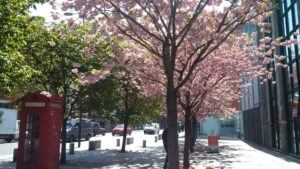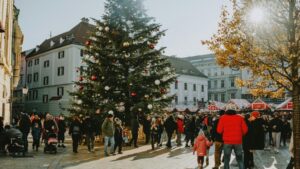
There is increasing awareness to the fact that mature urban trees improve the quality of life for people in cities and towns. Consider what our urban trees do:
- Sequester carbon dioxide and release oxygen
- Absorb as much as 48 pounds of CO2 per year and release enough oxygen to support two human beings (for each mature tree).
- Sequester one ton of CO2 per year at a cost of $25 (£15) /ton (Intergovernmental Panel on Climate Change).
- Store between 600 million and 990 million tons of carbon nationally.
- Yield positive energy benefits by reducing heating and cooling costs through shading and sheltering buildings
- A well-placed mature tree can reduce annual air conditioning costs by 2% to 10%.
- It has been suggested that planting 100 million mature trees in U.S. cities would reduce annual energy use by 30 billion kWh, saving $2 billion in energy costs. That amounts to $20 per year per tree.
- Help reduce urban heat island effect that causes urban areas can be as much as 8°F – 10°F warmer than adjacent rural areas.
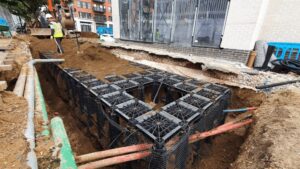
Urban trees, and in particular trees planted along city streets, are increasingly used as part of a green infrastructure programs to reduce stormwater runoff. Trees store rainwater in their roots and surrounding soil and then liberate the water vapor to the atmosphere through trans-evaporation. A tree’s root zone also absorbs water and enhances the penetration of surface water into the soil to further mitigate surface runoff. It has been estimated that 10,000 urban trees can retain approximately 10 million gallons of stormwater per year.
Studies have shown that rain gardens can be effective in retaining and trapping up to 95% of urban generated pollutants, therefore improving stormwater quality.
There are also strong economic benefits in creating and preserving mature urban trees. Urban forests provide a significant return on investment. A study conducted in Fort Collins, Colorado suggested that every dollar invested in urban trees returns a benefit of $2.18.
Think about the following:
- A presence of trees on your street and/or property has been proven to increase the value of your house.
- A property with trees is valued 5% to 15% higher than a comparable lot with no trees (Center for Urban Forest Research).
It is also suggested that planting urban trees is one of the most cost effective ways to reduce air pollution and decrease health problems. A 1994 study conducted in New York City estimated that the trees in New York City provided an estimated benefit to society of $9.5 million by removing 2,007 tons of air pollutants.
This makes urban trees a cost-effective solution to improving air quality in our cities. The pores on the underside of tree leaves are effective in removing sulfur oxides, nitrogen oxides, and volatile organic carbon. Whereas the leaves’ upper surface intercepts airborne particulates, contributing even more to a healthy urban environment. It was estimated that trees in Chicago remove approximately 234 tons of particulates.
Experts have also suggested that urban trees provide a restorative environment that allows people to have greater life satisfaction and relax more. In 1995, the Attention Restoration Theory was developed by Stephen Kaplan which proposed that natural environments, such as trees, can assist in developing greater attention and productivity. Urban trees have also been found to help children with Attention Deficit Disorder, with studies proving that ADD symptoms appear to be more manageable for a child in a treed area or other green/natural setting.
It is clear that our quality of life is improved by urban trees and that planting a single tree in an urban setting will yield significant return on the investment. Expanding our urban tree populations and greening our cities will clearly improve our quality of life.