Water Resilient Cities

GreenBlue Urban’s Head of Public Relations & Strategic Partnerships, Charlotte Markey, recently had the privilege of traveling to Bruges, Belgium with a member of the Natural Infrastructure Team from Plymouth City Council. Together they met collaborators from France, Belgium, and the Netherlands to discuss an EU Interreg project which focuses specifically on communities in what the EU defines as the ‘2 Seas’ area.

This includes the regions of:

  • England: South-West, South-East and East of England
  • France: Departments of Nord, Pas de Calais, Somme and Aisne
  • Belgium (Flanders): Provinces of West-Flanders, East-Flanders and Antwerp
  • The Netherlands: Province of Zeeland and the coastal areas of the Provinces of Zuid-Holland, Noord-Holland and Noord-Brabant
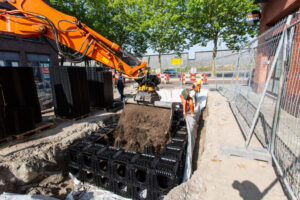
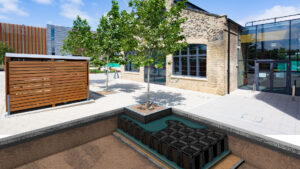
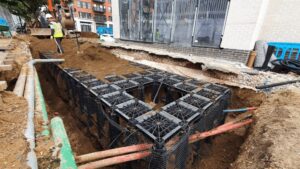
Presenting to our partners on the potential of LID / SUDs tree pit design in retrofit scenarios, provided a vital focal point for the basis of our funding proposal. It is apparent that knowledge of SUDs and nature based solutions for water management varies widely across the 2 Seas region, which makes the cross-border collaboration so vital for the future resilience of European cities to climate change and increasing health and liveability.

The main objectives of the project are to improve the capacity of cities in this area to adapt to heavy rainfall events, through innovative and creative LID / SUDs solutions in a retrofit context. One of the key focuses of the SUDs interventions would be to deliver schemes in constrained public spaces which would deliver societal benefits as well as saving public money through cost effective design and implementation.

There are many institutional barriers to achieving the most cost effective and desirable green and blue interventions across the urban areas which comprise the 2 Seas region. One of the major outputs of the project will be to address these obstacles through a demonstration of the potential of creative partnerships on five key demonstration sites. GreenBlue Urban is proud to be a major partner in this project. We will continue working to create innovative new solutions for such retrofit scenarios, specifically in older town and city centres with complex and often restrictive existing infrastructure.

Through establishing larger networks to facilitate knowledge exchange between private and public sector partnerships, our aim is to provide  transferable and replicable solutions which will be multifunctional,  providing the essential ecosystems services to the urban environments into which they are integrated.
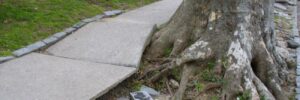
Trottoirs soulevés, chaussées fissurées, surfaces piétonnes inégales : lorsque ces problèmes apparaissent autour d'arbres matures, les racines sont généralement pointées du doigt.

Les populations d'arbres urbains dans les villes du monde entier subissent de fortes pressions. Malgré les avantages manifestes qu'offrent les arbres, notamment le rafraîchissement des rues,

Lorsque l'expression « strangulation racinaire » est mentionnée lors d'une réunion de devis ou d'une discussion de planification, elle a tendance à figer net la conversation.

L'un des défis les plus importants auxquels l'industrie du verdissement urbain fait face aujourd'hui réside dans notre capacité à répondre efficacement à l'accélération du climat

Planter un arbre est souvent perçu comme un acte d'optimisme, un geste tourné vers un avenir plus vert et prometteur. Toutefois,

Concevoir des aménagements urbains qui soutiennent à la fois la saine croissance des arbres et les exigences structurelles des chaussées, des sentiers et des zones carrossables

En milieu urbain, le sol réunit rarement les conditions nécessaires à la croissance et à l'épanouissement des arbres. L'espace racinaire restreint, la compaction et les conflits d'usage

Nos systèmes de drainage urbain existants sont sollicités bien au-delà de leur capacité initiale de conception. La densification du développement,

Chaque hiver, les villes prennent un air plus festif. Les rues s'illuminent, les marchés s'installent et, sur de nombreuses places publiques,

Les milieux urbains sont des espaces complexes et très sollicités où chaque centimètre carré de terrain remplit une fonction. Pourtant, même dans les zones à forte densité bâtie,