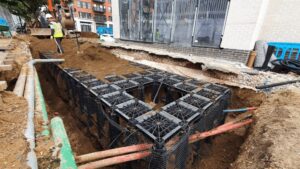
GreenBlue Urban have been involved for one year now in an EU Interreg project called Water Resilient Cities. This project aims to develop new capabilities and increase awareness of the issues of retrofitting strategic SUDs in our towns and cities. As part of the project output, GBU are establishing a network of private and public-sector partners to share knowledge and develop best practice principles. The first of our network meetings was held in Mechelen, Belgium, last week at the Lamont conference center in the heart of this fascinating city. The city is characterised by its beautiful regenerated areas with reopened waterways that have engaged and enlivened communities.
The first half of the conference was specifically focused on synergies between Water Resilient Cities and two other EU projects focused on water management; SCAPE and SPONGE 2020. Through an interactive workshop session, we agreed that some of the most important work surrounding integrating green infrastructure and sustainable urban drainage into our towns and cities rests upon the ways in which we can communicate the added benefits to health and climate resilience, and the metrics we use to measure the efficacy of our strategic interventions.
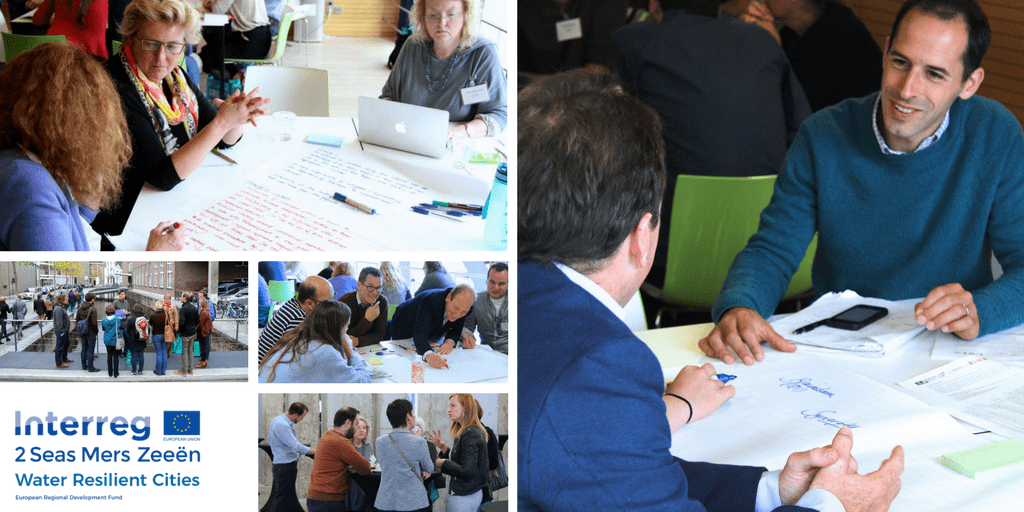
The second part of the day’s proceedings was a lovely mix of Belgian, French, Dutch and UK specialists giving short presentations on issues of design, implementation and policy together with the latest research and innovations. From the UK side, we were privileged to hear from Sue Illman from Illman Young, and Chryse Tinsley, a Landscape Architect from Leicester City Council who provided a series of creative and imaginative images to underline the importance of thinking outside of the box when it comes to designing SUDs schemes. This theme was ably taken up by Steven Slabbers from Bosch and Slabbers, Landscape Architects from Middleburg, Netherlands, who uses the mantra adaptive and attractive to convey the aesthetic aspect of integrating nature based solutions into the built environment. Steven Slabbers has provided the design work for the Mollenwater pilot project (Middleburg) in which GBU Arborflow system will be integrated.

The importance of providing an insight into the suite of solutions available to teams designing and implementing SUDs was communicated by Elias Desmot from ADOPTA. He presented a toolkit of solutions and noted that ADOPTA have a site where one can visit and see what could almost be considered a museum of products related to SUDs; something that teams all over the EU could benefit from.
With continued work with Alex Midlen, lead partner from Plymouth City Council, it is our ambition that the next event to be held in Bolougne sur Mer in April 2018, will be as inspiring and successful and that we can continue to reach out and engage with those for whom integrating SUDs isn’t quite as high up the agenda as it should be!