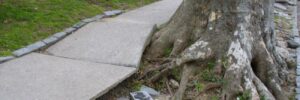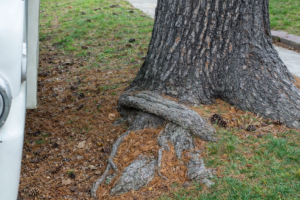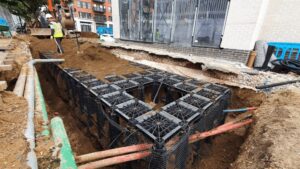
We need trees in our cities – but preventing tree roots from interfering with infrastructure is an ongoing issue. Utilities and other services are frequently encountered during construction of tree pits, but what is the best way to accommodate them?

SOIL CELL Infill
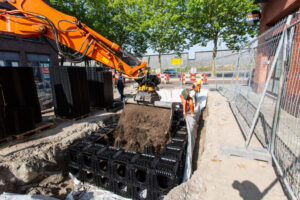
This method may be utilized for service corridors of 14″ (350mm) in width. The compact RC90 RootCell module is – in columns, and placed onto the sand layer surrounding the service pipe. These modules may then be loaded with soil concurrently with the adjacent StrataCell matrix, and finished with the geocomposite layer.

Granular Infill
This method entails placement of compacted granular material in the service trench, above the sand layer. Granular material is brought to level with the soil cell matrix, and overlaid with the geocomposite layer.

Shallow Services
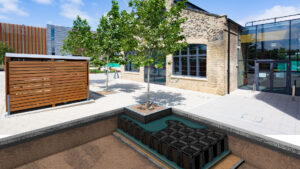
Where services may be relocated at shallower profiles, and pavement loads permit, the top soil cell layer may be amended to accommodate the pipe as shown. This method provides firm support for the service pipe or conduit, and more convenient access for repairs, if required.

Root barriers systems that avert the problem by directing tree roots away from surrounding infrastructure and services, like ReRoot™ from GreenBlue, are the most effective when running utilities through tree pits. ReRoot™ is a continuous root barrier with integral, molded vertical ribs for preventing ‘root swirl’ and directing roots downward and outward. This high density root barrier is made from 100% recycled postindustrial material and is now supplied to the industry in 10″ and 20″ deep rolls. The benefits of utilizing ReRoot™ are two-fold – through developing a deeper root system, the tree gains greater drought tolerance and improved stability. This material is best laid before the tree is established, though often the barrier can be retrofitted around mature or existing trees after the roots have been pruned from the damaged services. One of the great features about this product is the flexible design allows the barrier to curve around obstacles but is rigid enough to hold its form when back-filling. It also protects the tree when sidewalk reinstatement work is carried out.