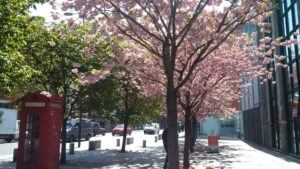
Rossa Donovan, environmental scientist for international consultancy WYG, has discovered a variety of trees that can improve urban air quality. The investigation was carried out using model scenarios to develop an Urban Tree Air Quality Score this was a applicable to all urban areas of the UK and other mid-latitude, temperate climate zones with common species to the UK.
The data was then fed into an atmospheric chemistry model which was used to model the combined effects of pollutant deposition to and the emission of biogenic volatile organic compounds. Analysing the results they were able to group trees into those that have the greatest potential to improve air quality, those which have a fairly mild or moderate impact on air quality and those which would have a detrimental impact on air quality if planted in very large numbers. Through a thorough investigation, Rossa Donovan discovered among the 30 species considered Cots pine, European larch and Silver birch have the greatest ability to improve air quality, whilst Oaks, Willows and Poplars can contaminate the air quality if planted in very large numbers.
Although trees play an important role in improving urban air quality by filtering particulate pollutants from the air, they can also negatively impact the air quality of urban atmospheres. Chemicals which are released through photosynthesis can react with traffic fumes to cause photochemical smog and air-borne particles, resulting in a number of chronic and acute medical conditions for those who live in cities.
The study shows that it is possible to assess the positive and negative impacts that urban trees have on air quality. Improving air quality is only one of the many ecosystem services that the natural environment can provide society. With further research it should be possible to quantify other benefits provided by, and the costs associated with, natural features and ultimately the contribution that they make to our economy.