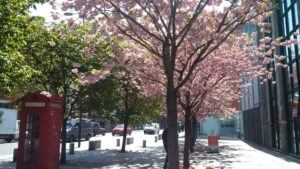
I have just returned from a once in a lifetime opportunity to travel across Israel, Jordan, and the Palestinian Territories. It is clear that what connects all the people living across these borders is a love of nature and a desire to integrate trees into their public realm and private residences. Walking on a warm, balmy night along the streets of Jerusalem, I was never far from an urban tree. The aesthetics of busy thoroughfares and transport hubs were enhanced by rows of trees, planted in the central area dividing traffic lanes and separating cyclists from pedestrians. Using integrated green and blue infrastructure as a means of encouraging considerations between users of different transport modes is something Jerusalem excels at. Despite the continued social and political divides, the very visible walls dividing communities, there is evidence that the land and the trees particularly, are a symbol of hope and well-being in a challenging and arid landscape.
Municipal Authorities across Israel, particularly in Jerusalem, have started to really explore the possibilities afforded by integrated green and blue infrastructure. In 2012 the SPNI (Society for the Protection of Nature in Israel) published a list of threats to open spaces and green infrastructure across the country and these challenges highlight the need for more sustainable urban drainage solutions and creative integration of green infrastructure across new developments. With increasing urbanisation and densification across the country and the projected population growth, there will be significant challenges for planners in Israel. Threats to biodiversity, water supply and the blazing summer temperatures in urban conurbations, necessitate innovative and creative approaches to planning new spaces and retrofitting some of the most beautiful and historic urban areas in the world.
Israel is making a new name for itself as a creative and tech hub. Jerusalem particularly is trying to define itself as a start-up capital. If the government wants to attract foreign investment and encourage start-ups, the working and living environments have to accommodate increasing demand for healthier more resilient spaces. Jerusalem and Tel Aviv have a friendly rivalry to be conceived of as ‘top city’ and it seems to me that this competitive streak amongst citizens of this respective cities could be advantageous for the future greening of both areas. The trendy bars and restaurants which characterise Tel Aviv culture are often screened by plastic trees and fake shrubbery, in planters. If the restaurants and bars want to save on air conditioning in the summer and mitigate against the fumes and traffic noises from the streams of cars and mopeds whizzing by 24/7, investing in the ‘real deal’ might increase revenue!
Eco Tourism is also on the rise and to maintain the natural beauty which changes rapidly from cityscape to desert, green and blue solutions and extensive tree planting are a vital ingredient in attracting tourists from Europe, Asia, and North America.
There is some way to go to realising the full extent of the possibilities that high quality integrated solutions for urban trees can provide in such difficult environments. With the sheer extent of new building planned, Israel could really seize an opportunity to become a showcase for a new eco-urbanism that is inclusive, creative and delivers growth that benefits all.